At present, the practice of catechesis, particularly among adults, has been almost completely lost. Modern discipleship programs concentrate on practices such as Bible study, prayer, fellowship, and evangelism and can at times be superficial when it comes to doctrine. In contrast, the classic catechisms take students through the Apostles’ Creed, the Ten Commandments, and the Lord’s Prayer—a perfect balance of biblical theology, practical ethics, and spiritual experience. Also, the catechetical discipline of memorization drives concepts deeper into the heart and naturally holds students more accountable to master the material than do typical discipleship courses – Excerpt,Introduction to the New City Catechism by Tim Keller.
At the heart of every church pleasing to the Lord is a church on mission with a commitment to making disciples who know God, love His Word, and live out their faith with gospel confidence. This gospel-centredness is evident in the life of CERC not just in adult ministry, but translates into the way children are discipled within families. Therefore, the unique gift of parenting and its corollary responsibilities, in particular the raising and discipling of children are seen as a corporate responsibility, one taken seriously by the Founding Elder, Pastor Robin Gan.
One aspect of this is ensuring that there is a formal catechizing of all children of church members. The undertaking of a formal catechism and a subsequent examination of faith prior to baptism by the Elder (should there be genuine profession of faith in Christ) is also a corporate act of gospel unity. It reflects the importance of ensuring the proper discipleship of godly offspring for gospel mission. Behind the process of catechism is the concern for the whole church to be grounded in the deep truths of God and start the process of theologizing well. To do this, parents catechizing their kids at a young age is key.
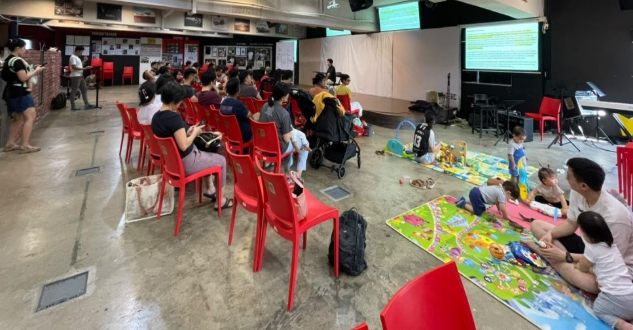
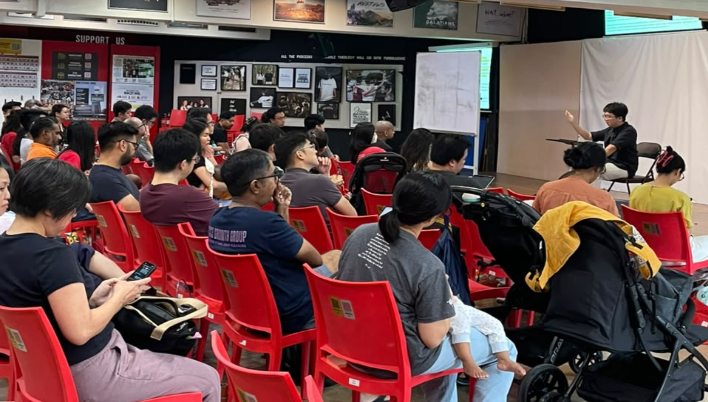
The first 2026 session for Catechism School of Christian Ministry (SOCM) was held on 2nd August 2026, 9.30am-11.30a.m. in CERC Central, Bandar Sunway, led by Pastor-in-Training Daniel Lu, with supplementary sharing from Carmen Chua on child development, and some parenting wisdom from Jeremy Johnson, older pioneer member from 2008 with 3 teenage children and 1 tween son. Around 50-odd parents with varying ages of children, from newborns up to teenage years showed up in order to reflect on the framework of thinking behind the formal catechism of their children, as well as listen to the wisdom of older parents who had already raised older children in the Lord.
True Christian education is not measured only by knowledge gained, but by lives transformed through obedience to God’s Word. Pastor-in-training Daniel Lu reminded parents that “the point of catechisms is not memorization, but theological dialogue and understanding – faith formation, and faith cannot be formed without knowledge – not perfect knowledge, but the right knowledge.” Thus, to begin teaching God’s truths to children from as young as possible and engaging them in theological dialogue and thinking is key to forming mature Christians. He also referenced Martin Luther’s preface to his own catechism, ‘The Small Catechism,’ who urged pastors to impress upon the people’s hearts God’s Words, and to begin doing so with the young. Children are to learn the text by ‘one fixed, permanent form and wording,’ and ‘after they have learned the text well, teach them also its meaning, so that they understand what they are saying.’
Parents were cautioned against thinking of catechism as procedural or merely a formal exam for their children to graduate from. Rather, developing and building the life of faith should not stop after baptism; there must be continued teaching, warning, feeding with the Word and dialogue in order to deepen discipleship.
When asked what was his one take-home from the morning’s training, Jared Mea said, “Catechism starts now, not something to wait to do when they can read or write, or are of schooling age, but it should be done the moment you start interacting with your kids. I took it for granted before this. My son is one-and-a-half, but we need to improve on planning better instead of randomly taking the book of the day.”
Irene Tan said, a mother to three teenage children said, “I didn’t know that the initial parenting and stimulation since young actually affects their learning… I can see that the parents in church spend a lot of time talking to their young children, reading to them and teaching them about God’s Word. Coming to church helps also but the everyday stimulation reinforces their understanding… they are better to grasp the catechism and it opens up their understanding.”
Another insight she shared was the importance of contextualizing God’s truths to the children whilst formally teaching them Christian doctrines in order for a thorough understanding to be developed, for which she recommended supplementing catechism questions with various bible texts and working through their original contexts while teaching.
“I had difficulty finding the right resources for my child when he was 9 or 10. Even with all the free resources available, it really depends on the parents to be thinking theologically to break down these truths and explain them at a child’s level,” said Irene.
The second half of the SOCM session covered a short discussion session amongst the parents on the nature of children and their development. Carmen shared that most children develop their approach to life by the age of three, sparking further discussion and reflection amongst parents of toddlers and newborns as to the urgency of being intentional in teaching and guiding their children from young.
Bolwin Su, another member and father of a 1-year-old, also posed a question regarding the degree of change one might inculcate in their children once they had passed the toddler phase However, older parent and member Jeremy Johnson shared that in spite of research, from his own experience as a parent of four teenagers, it is more important to know one’s own children well enough to disciple them without any rigid rules on the age of beginning catechism.
Jeremy Johnson also presented briefly on what he wished he would have done better, if he could re-do his parenting years, and at the heart of it was a desire to have been more intentional with formal teaching of doctrinal truths.
“Old-school parenting is where we believe it’s in the day-to-day discipline where God’s truths become real… it’s about modelling to your kids, not so much about formal systematic teaching,” he said. “But I wished I could have been more intentional in emphasizing formal teaching.” In closing the session, Jeremy’s last exhortation to younger parents was to start catechising their children as soon as possible.